The National Network for Children presented the 2026 Report Card on 30 April at Azaryan Theatre, National Palace of Culture in Sofia
The special 15th edition of the independent monitoring report “Report Card: What Is the Government’s Average Grade for Childcare?” brought together experts, representatives of institutions and civil society organisations, as well as young people from the Megaphone Youth Programme, to present the key findings on issues affecting children and families in Bulgaria.
The report assesses nine areas: Well-being; Family Environment and Alternative Care; Protection from All Forms of Violence; Justice for Children; Early Childhood Development; Education; Child Health; Sport, Culture and Leisure; and Child Participation.
A total of 50 authors and seven external evaluators contributed to the analysis and assessment. The lowest grades and a decline in performance were recorded in Well-being (2.96), Protection from All Forms of Violence (3.35), Education (3.17), Child Health (3.21), and Child Participation (3.13). Limited progress was recorded in Justice for Children (3.62).
The event was opened by Georgi Bogdanov, Executive Director of the National Network for Children (NNC), who stressed that today the Report Card is more important for Bulgaria’s children than it has been at any point over the past 10–15 years.
“The Report Card was created to serve as a guiding light for our politicians – a reference point for where policies for children need to go. Thousands of experts, parents, teachers, social workers and healthcare professionals have contributed to it over the past 15 years. The state has made progress, but there have also been major failures. One of them is that, for the sixth consecutive year, we have had no Strategy for the Child – a strategy that politicians allowed to fall victim to propaganda,” he said.
The event was moderated by Bella Damyanova, Child Policies Coordinator at NNC. Thomas Stauffer, Head of the Swiss Contribution Office, also took part in the opening session.
The presentations across the nine areas of assessment combined expert perspectives with the voices of young people.
The topic of Child Participation was presented by Denis Yordanov, an alumnus of the Megaphone Youth Programme, who emphasised the need for children to be genuinely heard, for different voices to be given space, and for all children to have opportunities to participate.
Blagovesta Tsenova, Head of the Children’s Palace in Ruse, focused on opportunities for sport, culture and leisure.
“Free time is where ideas and creativity are born. This is where we put children at the centre. They do not want to be entertained – they want to create. We just need to believe in them,” she said.
Irina Manusheva, literary translator and advocate for meaningful education, outlined some of the key challenges facing Bulgaria’s education system.
“We have made education subordinate to assessment rather than knowledge, at an enormous cost in stress and resources for parents, teachers and taxpayers. But children pay the highest price for poor education. A single high-stakes exam determines their future and forces them, at the age of 13, to choose professions that may no longer even exist in the future. This is not the right to education.”
She added that research shows that punishments, sanctions and reprimands at school do not work, and that children need a kind of support that artificial intelligence cannot provide.
Plamena Nikolova, Head of Early Learning at Rise Bulgaria Foundation, presented the topic of Early Childhood Development. She noted that policies for children have deteriorated, particularly in the aftermath of the COVID-19 pandemic and the war in Ukraine. At the same time, the period up to the age of five is crucial for children, as this is when much of their potential develops.
“The right approach is through play and active learning,” she said.
The topic of violence and the child protection system was presented by Diana Dimova, Chair of Mission Wings Foundation. She symbolically showed a red card to everyone – institutions, society and each of us – for the lack of effective prevention of violence against children.
“Every delay or every child at risk who is forgotten can result in that child becoming part of the grim statistics,” she warned.
The perspective on Child Health was presented by Dr Boyana Petkova, physician and human rights advocate. She also addressed the National Children’s Hospital, describing the project as “a test of our humanity.” Bulgaria is the only EU country without a national children’s hospital.
“We want a hospital where children do not feel as though they are being punished for being ill. An average grade is not good enough for our children,” Dr Petkova said.
Alexander Milanov, Executive Director of the National Foster Care Association, focused on family environment and alternative care. He noted that the system knows what the right thing to do is, but does not have sufficient conditions to make it happen.
“Structural problems require structural solutions,” Milanov said.
Georgi Elenkov, Child Policies Director at NNC, addressed the issue of Justice for Children.
At the end of his presentation, he called for the long-awaited reform of the juvenile justice system to finally become a reality, stressing the need for a clear vision, expert consensus and broad political will.
Maria Brestnichka, Programme Director at NNC, presented the data and findings on children’s well-being – the most critical area in the report.
“To quote the introduction to the Report Card – we do not need new campaigns. It is time for statesmanship. Statesmanship that sees children. It is time to stop beating down those who are trying to climb the ladder. It is time to change not just the monkeys, but the rules of the cage itself. Because our children do not deserve a state that runs on inertia, but one that has the courage to look up,” she said.
Bella Damyanova, Child Policies Coordinator and moderator of the event, emphasised that while the Report Card gives the government a grade, behind that grade lies responsibility.
“Responsibility for what we see. How we respond and what we choose to change. Because policies for children are everyday governance decisions with long-term consequences for the years ahead. We believe that each of us is part of the solution – not tomorrow, but today,” she stressed.
More about Report Card 2026
Report Card 2026 marks 15 years since the report was first published and 20 years since the National Network for Children was founded – two decades of consistent civil society monitoring, dialogue and advocacy for policies for children based on evidence, analysis and the participation of children and young people themselves.
The grading system used in the Report Card follows the Bulgarian school grading scale – from Poor (2), when the state has taken no action to address the problems identified in a particular area, to Excellent (6), when effective measures have been introduced and their impact has been demonstrated.
What Lessons Have Politicians (Not) Learned in 15 Years?
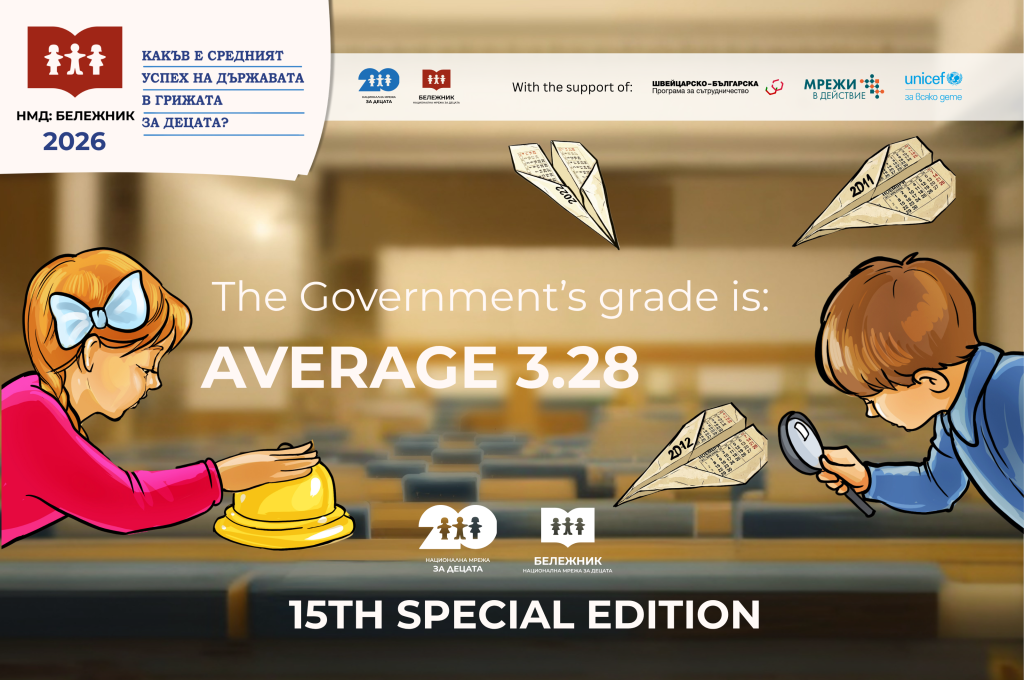
The average grade of 3.28 once again places Bulgaria in the “Average” range, as in the previous two editions of the report. The analysis identifies progress in some areas, but also serious challenges related to poverty, unequal access to services, lack of coordination between systems, and limited participation of children in decision-making processes.
For more than 15 years, children have consistently been declared a priority by Bulgaria’s institutions. The Constitution itself stipulates that families, motherhood and children are under the protection of the state and society, while legislation clearly establishes every child’s right to protection, development and participation. Yet over the past 15 years, these principles have rarely translated into consistent and sustainable policies that genuinely improve children’s lives.
Public discourse frequently repeats that “children are the future,” but this rhetoric is rarely backed by comprehensive solutions. The data reveal persistent challenges: a declining child population, high levels of child poverty and social exclusion, and deep inequalities in access to healthcare and education. One in three children in Bulgaria is at risk of poverty, while their opportunities for development continue to depend heavily on the circumstances into which they are born. Infant mortality has fallen by half, but significant inequalities in access to healthcare remain.
The education system has achieved higher participation rates, but has failed to overcome the strong link between a child’s social background and educational outcomes. International studies show that the acquisition of basic skills and functional literacy remains a challenge, while the quality of education varies significantly. At the same time, reliable data are lacking on key aspects of children’s lives, including their experiences of violence, making effective policy planning more difficult.
These problems are compounded by the lack of a consistent strategic framework. Since 2019, Bulgaria has had no comprehensive national policy for children, while measures remain fragmented across separate programmes, often without coordination or clearly measurable outcomes. The State Agency for Child Protection – the main institution mandated to coordinate the system – has gradually seen its powers restricted and lacks effective tools for managing the system.
The crises of recent years – the pandemic, the war in Ukraine and the increased number of refugee children – have further exposed the system’s weaknesses. Issues such as child poverty, online violence, early intervention and children at risk require a coordinated approach involving multiple institutions, which is currently lacking.
Despite individual reforms, including deinstitutionalisation and the Pre-school and School Education Act, systemic change remains incomplete. These reforms have changed structures, but have not always transformed practices in ways that place the child at the centre of policymaking. As a result, many efforts remain fragmented and fail to produce long-term impact.
All of this raises a fundamental question: What is the state’s real vision for children in Bulgaria?
The lack of coordination, a strategic framework and impact-assessment mechanisms results in policies that are often reactive rather than preventive. Resources are consequently spent without being linked to clear objectives and measurable outcomes.
The Report Card therefore asks institutions two fundamental questions: What lessons have been learned – and which have been missed – over the past 15 years? Where are Bulgaria’s children today, not as an abstraction in political promises, but as real lives that need consistent, effective and accountable policies?
NNC’s media partners are Manager, Darik, Actualno.com and Bulgarian National Television.